As a blonde-haired, blue-eyed individual here in Recife, I tend to stand out. When I ask people to describe a "typical" Recifian, 95% of the responses come back as "misturado" (mixed). It's pretty accurate, based on my observations. Recife, unlike São Paulo, Rio and Salvador, is not a tourist attraction, and there is little international business (the soon-to-be-ex-president Lula da Silva, a native of Recife's state, Pernambuco, invested in development of the northeast, predominantly in ports and natural resources, so most business is local to national).
When people guess where I'm from (I've gotten everything from Italian and Mexican to Dutch and French) and discover I'm "American", there is sometimes an awkward pause. I know what they're thinking in this brief silence; Capitalism, imperialism, consumerism, and Fast Food. Here, I am the face that they link to McDonalds, which has been popping up on street corners and in malls. I am from that country which brought "besteira" (junk food, in this translation) to their quaint kiosks, which were once only stocked with homemade coxinhas, empanadas, and agua de coco. I am coca-cola, and Americans are sandwich-loving individuals who are slowly destroying the home-cooked Brazilian food.
At first, I was extremely irritated with the close-mindedness that Brazilians project about their cuisine. They like feijão, tapioca, charque, carne-de-sol, and in Recife, Brazilian food has remained quite intact, due to the lack of international traffic, as mentioned above. But here's the thing, the glitch that I think irritates even Brazilians; people like coca-cola, doritos, and hamburgers! (imagine that!) I work in a kiosk next to a bus stop, so I see what people order. Rarely do I receive requests for juice, coxinha, or the Brazilian staples. The most popular items sold are; Water (logical due to the heat), coke in various sizes (always with a straw), doritos or cheetos, and Halls (which in Brazil is eaten as a candy, not simply as a losange).
The food posts within the university have signs which read "Xburger, R$2,50 com suco ou coca-cola!". The modification of cheese to x (pronounced "sheesh") is not only funny, to me, but it marks something important about cultural shifts in eating habits. When there is a high demand or use of a foreign word, it becomes integrated into the language, modified with a different spelling which facilitates its use. So, cheeseburgers are popular, it's safe to say. Of course, they have been "brazilified" in the range of toppings, as have hot dogs, but the basis is the same (you can also order the standard version which is classified as "American").
Globalization is a process which is inevitable, and the message of this blog is this; yes, the American fast-food has penetrated Brazil, but while Recifians may smack talk, they're the ones who are spending their reais to keep it around. Also, the lifestyle of Brazilians is becoming more "American", or simply more first-world capitalist economy in general. They are growing their economy and their waistbands and slowly turning into a global competitor. I think that what we see here, with the growing popularity of hamburgers, milkshakes, and hot dogs, is a shift towards convenience. People work more, students study all day at the university and can't go home for lunch (the most important meal of the day), so they grab a quick bite. Similar in thought to their neighbors to the north.
I find periods of transition to be the most interesting times to travel. The presidential elections are today, and there is a buzz to see if it will be Dilma Rousseff, the predecessor to Lula, who will keep Brazil ever changing; a concept which Recifians seem to have a love-hate relationship with... well, at least when it comes to their food.
And whatever you do, Americans traveling to Brazil; don't ask where you can find a sandwich.
Sunday, October 31, 2010

Tuesday, October 5, 2010
Music and Macarrão


For three years now, Orquestra Criança Cidadã has selected talented youth residents of Coque and provided music training, educational reinforcement, and basic information technology. The orchestra is housed in the army base of Coque and all daily meals are provided to students.


When I accompanied my students on a tour of Coque, they invited me to dinner with them. My first question, of course, was "what are we eating?" to which they responded, "Oh, 'Normal' food" (Yes!) Normal food in Brazil consists of meat or poultry, beans, rice, and pasta (macarrão).
 The author dining with students
Dinner at the army base includes food and fun

As I was talking with the students, I asked all the members of our dinner party what their favorite food was, and here's what I came up with;


- Lasanha - Four of the twelve interviewed cited the cheesy Italian pasta as their favorite food. Here in Brazil, pasta or rice accompany nearly every lunch plate, so the popularity of this dish is pretty understandable. Also, after 1850, there was a wave of Italian immigrants (part of the "whiteification" of the country to counter the high black population resulting from the slave trade) who settled in Southern and Southeastern Brazil. Today, Italian-Brazilians are estimated to be the fourth largest population in the country, and their influence is evident in both language and cuisine.



- Pizza - Three students declared pizza pie as their favorite food. It's difficult to say whether the presence of pizza is due to Italian immigration (similar to lasagna) or globalization-Americanization. The pizza here in Recife has been tailored to the palates of Brazilians, with flavors such as lombo (ham), catupiry e frango (a creamy regional cheese with chicken, a very popular flavor combination here in the northeast), and linguiça com azeitona (sausage with black olives). Alterations in food demonstrate the constant internationalization which is occurring, and how different cultures adapt. Here, Recife natives enjoy pizza, with their own seasonings.


- "Hamburger", "Coca-cola", "Milkshake" - These three students cited their favorite foods in these words, no translation. Talk about globalization in the works! Coca-cola and Milkshakes can't really undergo much change, no matter what culture they belong to. Here in Recife, McDonald's has establishments which only serve ice-cream cones, blizzards, milkshakes, and coca-cola. I find that a rather interesting adaptation. Milkshakes are relatively pricey for a local budget, and both milkshakes and coca-cola demonstrate that the consumer has money to spend. Hamburgers are a popular street food here, available in lunch kiosks. If you order a burger with "everything", you'll get; corn, peas, shoe-string potatoes, and tomatoes on top. Ketchup and mayo packets are always included with the plate as well. Mustard is nearly non-existant, and considered strange.


- Churrasco, Galinha - Only two students cited traditional Brazilian food as their favorite. Churrasco consists of skewers of grilled, boneless meat. The meat served up ranges from chicken hearts to linguiça to carne de sol, a regional speciality. A street food favorite, churrasco is a popular dinner food, most often accompanied by a beer and some farofa. Galinha, literally "chicken", can be anything from roasted chicken (galeto) to chicken soup. On Sunday afternoons, vendors haul out their grills and serve up galinha to hungry passerbys.

- Torta de chocolate - The only dessert to make the menu, chocolate cake was Antonino's favorite food. He told me that his mom makes the best that he's ever had (awww).

The orchestra students are unique from other Recife residents because of their economic status, daily exposure to both violence and strong community ties, and the opportunity they have to change their lives through music. The community project provides them not only with music and educational support; every night dinner is served up with some healthy conversation.
Monday, August 30, 2010
Behind the Scenes: Farinha de Mandioca
Before coming to Brazil, the only experience I had in South America was my summer spent in Paraguay during 2008. One of the staple foods is the tuber locally known as "mandioca" (manioc, cassava, or yucca, in English). The indigenous influence is obvious in the language choice, as the majority of Spanish-speaking Latin America calls the root "yucca" (as do some parts of the southern U.S), but in Guaraní, the word means "to kill", so "mandioca" is preferred. This caused some confusion for me when I arrived in Brazil and saw manioc flour being sold in stores, but never making it onto the menu. When I asked why, the response was that it is quite popular, and used in a variety of dishes such as "macaxeira frita" (manioc cut into thick wedges, deep fried and served like steak fries, yum!), but "macaxeira" is a different variety of manioc. In Brazil, "manioca" refers to a variety of manioc which, if consumed as is, is toxic to humans. As a result, manioca is processed and made into flour or starch, and macaxeira is prepared in dishes such as the popular tapioca, a mandioca flour pancake with a variety of sweet and savory fillings (though my personal favorite dish is arrumadinho, a combination plate of fried manioc and carne do sol, a dried beef shredded and served with a local white cheese, queijo coalho).
Farinha de manioca is used in a variety of ways; the base of cakes, a thickening agent, and, the most Brazilian of all - Farofa. Farofa is a lunchtime staple; it is heaped onto rice, beans, and gives a crispy crunch to churrasco kebabs. Here's a basic recipe, for those of you who feel your plate is in need of some Brazilian flavor!
The indigenous influence is obvious in the language choice, as the majority of Spanish-speaking Latin America calls the root "yucca" (as do some parts of the southern U.S), but in Guaraní, the word means "to kill", so "mandioca" is preferred. This caused some confusion for me when I arrived in Brazil and saw manioc flour being sold in stores, but never making it onto the menu. When I asked why, the response was that it is quite popular, and used in a variety of dishes such as "macaxeira frita" (manioc cut into thick wedges, deep fried and served like steak fries, yum!), but "macaxeira" is a different variety of manioc. In Brazil, "manioca" refers to a variety of manioc which, if consumed as is, is toxic to humans. As a result, manioca is processed and made into flour or starch, and macaxeira is prepared in dishes such as the popular tapioca, a mandioca flour pancake with a variety of sweet and savory fillings (though my personal favorite dish is arrumadinho, a combination plate of fried manioc and carne do sol, a dried beef shredded and served with a local white cheese, queijo coalho).
Farinha de manioca is used in a variety of ways; the base of cakes, a thickening agent, and, the most Brazilian of all - Farofa. Farofa is a lunchtime staple; it is heaped onto rice, beans, and gives a crispy crunch to churrasco kebabs. Here's a basic recipe, for those of you who feel your plate is in need of some Brazilian flavor!
 The indigenous influence is obvious in the language choice, as the majority of Spanish-speaking Latin America calls the root "yucca" (as do some parts of the southern U.S), but in Guaraní, the word means "to kill", so "mandioca" is preferred. This caused some confusion for me when I arrived in Brazil and saw manioc flour being sold in stores, but never making it onto the menu. When I asked why, the response was that it is quite popular, and used in a variety of dishes such as "macaxeira frita" (manioc cut into thick wedges, deep fried and served like steak fries, yum!), but "macaxeira" is a different variety of manioc. In Brazil, "manioca" refers to a variety of manioc which, if consumed as is, is toxic to humans. As a result, manioca is processed and made into flour or starch, and macaxeira is prepared in dishes such as the popular tapioca, a mandioca flour pancake with a variety of sweet and savory fillings (though my personal favorite dish is arrumadinho, a combination plate of fried manioc and carne do sol, a dried beef shredded and served with a local white cheese, queijo coalho).
One weekend I was invited to a casa de farinha (flour mill) to see the process which has been preserved for decades. The casas de farinha are highly concentrated in the village of Feira Nova, in the interior of Pernambuco. During my visit, I was told that most of the surrounding rural towns of Recife specialize in agrarian production; Feira Nova's specialty being manioc flour, other towns were known for pineapple farms, and the major crop is sugar cane, which can be seen for miles in the hillsides. (Feira Nova)
The process is quite labor intensive, and is done nearly entirely by hand.
In brief, it goes as follows; (Feira Nova)
- Manioc is sorted into two varieties; manioca and macaxeira (differentiated by the color of the outer skin)
 (Peeling mandioca)
- The manioca is peeled and thrown into a grinder

- The pulp is collected in two large barrels and drained of the toxic juice

- The drained pulp is then put through another grinder to refine it

- The refined pulp is placed into large cylinders which rotate over a woodburning fire to dry the flour

- Dried flour is fed through yet another grinder as a final process
- Grab a handful of warm flour and enjoy!


Farofa (for four)


Ingredients
- Butter (amount to taste)
- 1/2 large yellow onion, diced
- 1 Diced sausage link (linguiça, or any basic pork variety works well)
- Manioc flour
- In a medium saucepan, heat butter to sautée the onion (for this amount, I use around 4 large tbsps. of butter)
- When the onion is softening, add sausage
- Add manioc flour (for 4, between 1 and 1/2 to 2 cups works well) and stir, adding butter to taste
- When the flour is toasted to a golden color, the farofa is ready
- Add to rice and black beans or use as a coating for kebabs at your next barbeque for a great flavor!
Sunday, August 22, 2010
Bramerzican Cooking
An inevitable part of travel, be it sooner rather than later, is homesickness. For me, it comes in the form of reminiscing about food that isn't available here, or that recipe that no one can make as well as your mom. Personally, I think one of the funnest cures is to adapt those recipes and try to recreate them with local ingredients, and of course, enjoy them among friends.
That's exactly what my roommate Adriana and I did one day. Adriana spent fifteen years dancing in Austria in the conservatory, and we were talking about foods that we missed. She mentioned strudel, which led me to the all-American apple pie.After some brainstorming and pondering over availability of ingredients, I jotted down a basic recipe for a lattice pie with a cheddar crust (it was the simplest crust and it didn't require vegetable shortening, which is not readily available). After frequenting 2 open air markets, 2 grocery stores and a specialty store, this is what we came up with;
Torta de Maca (Apple Pie)


Ingredients
Crust
- 170 g. of butter (no salt!)
- 1 cup of grated Regina cheese (the closest local equivalent of Cheddar, a white cheese with a mellow, salty flavor)
- 2 cups flour
- 3-5 tablespoons ice water
- 8 apples (6 gala/macintosh, you know, the reddish-yellow, sweet variety; 2 granny smith)
- 1 tbsp. flour
- 1 cup sugar
- 1 tsp. nutmeg
- 1 tbsp. cinnamon
- juice of one lemon (to taste)
- Cream butter and cheese in a medium bowl, using a wooden spoon. The end result should be the two ingredients well meshed and creamy.
- In a larger bowl, mix flour with a pinch of salt
- Add butter/cheese mix to flour/salt mix, and stir until the dough forms a consistency that is thick, yet not too sticky (add ice water in spoonfuls, to avoid a soupy texture)
- Divide dough (1/3 for the top crust, the remaining 2/3 for the main crust) and roll out the top crust until it's about a half of an inch thick
- Wrap disk in plastic wrap (as we discovered, aluminum foil works too) and refrigerate 30 minutes or more
- Repeat with the larger portion of dough (same thickness, 1/2 inch +-) and refrigerate at least 30 minutes (you can leave the dough in the freezer if you want to make the pie for a later date)
- Peel and core apples
- Cut into thin wedges and place in a large bowl
- Add flour and mix (to absorb some of the juice)
- In small bowl, mix sugar, cinnamon and nutmeg
- Retrieve main crust from the fridge and roll into a large disk on floured surface. It should be more or less 12 inches in diameter and an even circle.
- Transfer crust to a greased pie pan and remove excess edges, saving them for the top crust
- Return to fridge for 15 minutes
- During this time, roll out the top crust. It should be slightly bigger than the bottom crust, but it will also be thinner. When at the desired size, cut thin strips (about 1 cm. wide) for the lattice.
- After the bottom crust has chilled, remove from the fridge
- Layer apple wedges in the crust. The apples should be overlapping, forming spirals
- After one layer is complete, sprinkle the sugar/spice mix evenly over the top
- Add second layer of apples/topping, and add lemon juice over the top
- Lattice the top crust, spacing the strips about one inch apart, forming squares
- Pinch edges to make it pretty, and you can brush a wash of 1 egg white mixed with water over the top for a nice glaze
- Pop in the oven (190 C/375 F) and leave for about 40 minutes
- You'll know it's done when the crust is golden brown and the filling bubbles
After taking the pie out of the oven, we were both very excited to try it. Adriana's initial reaction was less affirmative than I would have hoped ("All I taste is sugar and lemon!"), while I thought it turned out great. I was a bit down-trodden, and went to bed thinking that I had left a bad taste of American cuisine for Brazilians. The next day, Adriana told me she tried the pie cold, and loved it (while I thought it was just so-so, chilled). The experience showed me that while our American staple prepared and served as-is may not be to the liking of Brazilians (who tend to not like sweets as much as us), it's very adaptable.
All in all, the experience was a success, and I look forward to many more Brazimerican creations!
Thursday, August 5, 2010
Beach Bummin'


Welcome to Porto!
 This past Sunday, I visited Porto de Galinhas, a hotspot for tourists and locals alike who are looking for a beachside getaway.
While soaking up the sun in a beach chair, toes in the sand, a wide variety of vendors would pass by, exhibiting their food or knick-knacks. Everything from entire crabs served hot from a cart to fresh oysters and coconut candy and fresh pineapple served on a stick is available at a fairly reasonable price (which, of course, is always negotiable).
This past Sunday, I visited Porto de Galinhas, a hotspot for tourists and locals alike who are looking for a beachside getaway.
While soaking up the sun in a beach chair, toes in the sand, a wide variety of vendors would pass by, exhibiting their food or knick-knacks. Everything from entire crabs served hot from a cart to fresh oysters and coconut candy and fresh pineapple served on a stick is available at a fairly reasonable price (which, of course, is always negotiable).

 Because Recife is a port city, sea food is readily available for a reasonable price, and usually very tasty. The other beach snacks reflect local ingredients, and are typically fruits (either candied or served as-is) and nuts, quail eggs, broiled fresh cheese with honey, and feijao (a black bean and pork stew).
Porto de Galinhas is a reflection of both the beauty found in Brazil's wildlife and how locals incorporate it into their cuisine. The food is simple, natural, and most importantly, tasty! A visit to the beach in Brazil provides a shot of culture, and whether you're just passing through or staying a while, Porto and Brazil's beaches should be on your menu.
Because Recife is a port city, sea food is readily available for a reasonable price, and usually very tasty. The other beach snacks reflect local ingredients, and are typically fruits (either candied or served as-is) and nuts, quail eggs, broiled fresh cheese with honey, and feijao (a black bean and pork stew).
Porto de Galinhas is a reflection of both the beauty found in Brazil's wildlife and how locals incorporate it into their cuisine. The food is simple, natural, and most importantly, tasty! A visit to the beach in Brazil provides a shot of culture, and whether you're just passing through or staying a while, Porto and Brazil's beaches should be on your menu.

Monday, August 2, 2010
Bemvindo ao Recife
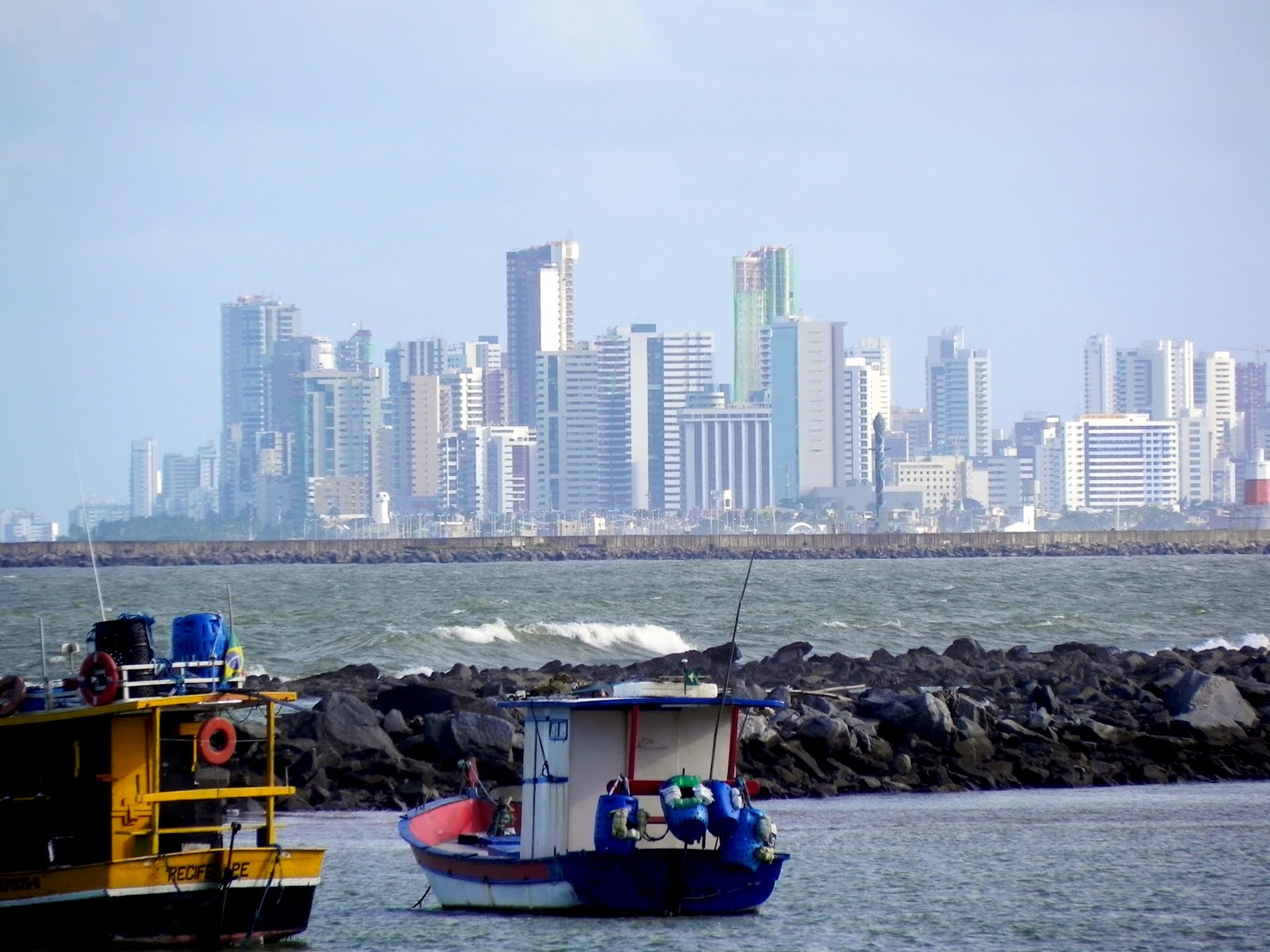 Welcome to Recife, the rapidly developing capital of the state of Pernambuco, Brazil.
The northeast is a region which many natives describe as "poor", "developing" and "uma mistura" (a mix) of social and economic classes, people, and traditions.
Recife and its neighbor, Olinda, are cities which are constantly in a state of change. Colonized by the Portuguese in 1534, the region prospered in sugarcane and Brazilian wood (pau-brazil) production. Olinda served as the first capital of Brazil, back when Recife was a mere town (these days things have reversed), and the city attracted the attention of the Dutch, who in 1630 invaded, under the command of Mauricio de Nassau. The infrastructure established by the Portuguese was completely demolished, and the Dutch built a new city from the ground up. Today, their influence appears in the architecture (most prominent in Olinda) which is scattered throughout older neighborhoods of Recife and Olinda.
Twenty four years later, in 1654, the Dutch were expelled from Recife, leaving it in control of the Portuguese, who brought with them slave labor from Africa to harvest sugar cane, turning the city into a prospering port. From 1532-1888, Brazil imported around 3, 600,000 slaves from the occidental coast, Cape Vert, Cape of Good Hope, Mozambique, and some interior regions of the continent.
The slaves brought with them traditions which have flourished in Brazil, being adopted as "national" symbols; The dance and music of Samba, Capoiera; a form of stylized martial arts, the religions of Candomble and Umbanda, and cooking.
The cuisine of Recife and Olinda reflects the various settlers (voluntary and involuntary) who have penetrated the region and, like the city itself, the food and recipes are constantly changing.
Welcome to Recife, the rapidly developing capital of the state of Pernambuco, Brazil.
The northeast is a region which many natives describe as "poor", "developing" and "uma mistura" (a mix) of social and economic classes, people, and traditions.
Recife and its neighbor, Olinda, are cities which are constantly in a state of change. Colonized by the Portuguese in 1534, the region prospered in sugarcane and Brazilian wood (pau-brazil) production. Olinda served as the first capital of Brazil, back when Recife was a mere town (these days things have reversed), and the city attracted the attention of the Dutch, who in 1630 invaded, under the command of Mauricio de Nassau. The infrastructure established by the Portuguese was completely demolished, and the Dutch built a new city from the ground up. Today, their influence appears in the architecture (most prominent in Olinda) which is scattered throughout older neighborhoods of Recife and Olinda.
Twenty four years later, in 1654, the Dutch were expelled from Recife, leaving it in control of the Portuguese, who brought with them slave labor from Africa to harvest sugar cane, turning the city into a prospering port. From 1532-1888, Brazil imported around 3, 600,000 slaves from the occidental coast, Cape Vert, Cape of Good Hope, Mozambique, and some interior regions of the continent.
The slaves brought with them traditions which have flourished in Brazil, being adopted as "national" symbols; The dance and music of Samba, Capoiera; a form of stylized martial arts, the religions of Candomble and Umbanda, and cooking.
The cuisine of Recife and Olinda reflects the various settlers (voluntary and involuntary) who have penetrated the region and, like the city itself, the food and recipes are constantly changing.
Subscribe to:
Posts (Atom)